What is a henka? The sidestep that can make a crowd go quiet
A henka is a sidestep at the tachiai: instead of charging straight into the opponent, a wrestler dodges to the side at the last instant, using the other wrestler's own forward momentum to send him off balance or out of the ring. It is not a forbidden move, so the win counts fully - but especially from a higher-ranked or much bigger wrestler against a clear underdog, it is often seen as an unsatisfying way to win, and the arena can react with silence or groans instead of cheers.
How harshly a henka is judged depends on who used it and against whom - the Association does not penalise it, so reactions come from the crowd and commentary, not the rules. Japan Sumo Association ↗
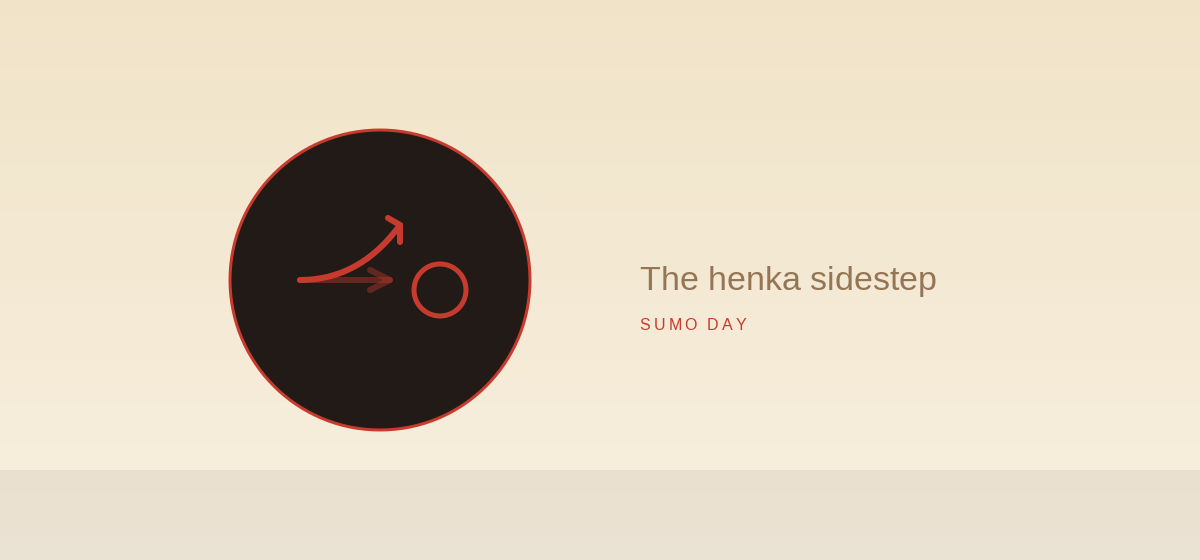
What you are seeing
- Both wrestlers explode forward at the tachiai as usual, but one of them pivots or slides sideways instead of meeting the charge.
- The opponent, committed to a straight-ahead charge, often stumbles past or topples from his own forward momentum with little contact.
- The bout can be over in a single step - sometimes faster than a normal tachiai collision - which is part of why it reads so differently from your seat.
What to watch next
- Watch the crowd, not just the ring: a henka win by a favourite is one of the few results that can draw groans, murmurs, or silence instead of applause.
- Notice who used it. A small wrestler sidestepping a much larger one is usually read as a sensible tactic; a yokozuna or ozeki doing it to a lower-ranked underdog draws far more criticism.
- Check the kimarite announced afterward - a henka itself isn't a kimarite, so the win is usually credited to whatever finished it, such as a push-out or a hikiotoshi (hand pull-down).
A common first-timer mistake
Assuming the sidestepping wrestler broke a rule. He didn't - henka is legal sumo, not a kinjite. What changes is how the crowd and commentators judge the manner of the win, not whether it counts.
Words you may hear
- Henka
- a sidestep at the tachiai instead of a straight charge
- Tachiai
- the synchronized opening charge at the start of a bout
- Kimarite
- the winning technique announced after the bout; henka itself is not one
Sources and review
Created and photographed in Ryogoku by a Tokyo-based spectator. Facts reviewed against Japan Sumo Association materials on 27 October 2026.